Vibration Test – Applying Pressure to Products to Reveal Hidden Defects
Vibration Test – Applying Pressure to Products to Reveal Hidden Defects
Have you ever experienced a phone that starts flickering after a few months, only to work again after a firm tap? Or a headlight where one LED begins to intermittently fail after some time on the road? The root cause is often not the material quality itself, but the accumulated microscopic damage caused by long-term vibration. Vibration testing exists precisely to uncover these hidden issues before they reach the user.
Core Function & Application
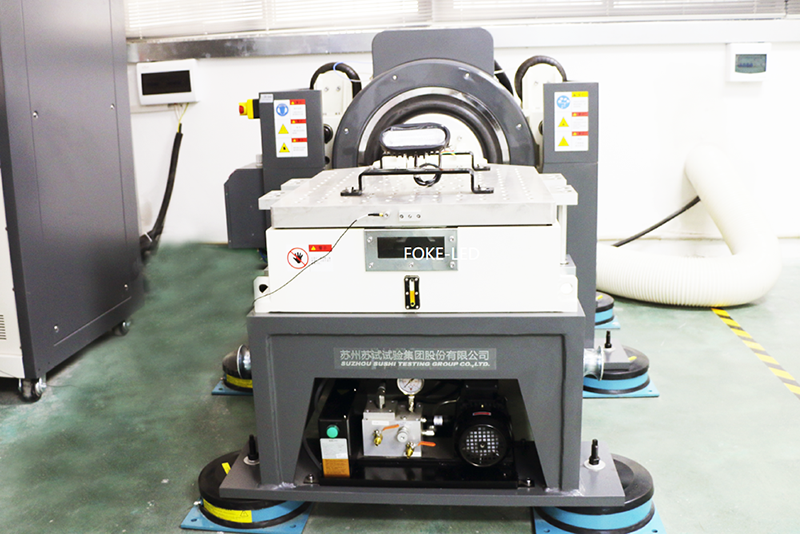
The core function of vibration testing is to simulate the various vibration environments a product may encounter during manufacturing, transportation, and daily use, evaluating its structural strength, functional reliability, and vibration resistance life. In simple terms, it applies controlled “pressure” to a product to expose potential design or manufacturing flaws that real-world vibration might cause. A product that sits perfectly still on a lab bench is not necessarily one that will survive a bumpy road. The value of vibration testing is to let products undergo a “trial by shaking” before they ever leave the factory.
Which Industries Rely on It?
In consumer electronics, devices such as smartphones, tablets, and wearables are densely packed with tiny PCBs, solder joints, and connectors. Everyday actions like dropping a device, shaking inside a bag, or jogging with a wristband all generate continuous vibration that affects these internal structures. Vibration testing verifies the vibration resistance of these components, preventing contact issues, display malfunctions, or functional failures caused by long-term vibration.
In automotive electronics, the importance of vibration testing becomes even more critical. Road bumps, continuous engine vibrations, and wind pressure pulsations at high speed — all of these vibrations are transmitted to every component inside a vehicle. Engine control units, sensors, headlights, wiring harness connectors — any single point of loosening or failure under long-term vibration could lead to serious consequences. Vibration testing ensures that these components remain reliable over tens of thousands of kilometers of driving.
In aerospace, the vibration environment in flight is far more complex than on the ground. High-speed rotation of engines and propellers, severe turbulence through turbulent air, and impact loads during takeoff and landing all generate high-frequency, high-intensity vibration. Vibration testing verifies the functional reliability and structural integrity of avionics, instrument panels, navigation systems, and other airborne equipment under high-frequency vibration, ensuring flight safety.
In military equipment, vibration testing is a mandatory requirement for meeting military standards such as GJB 150.16A. From transportation jolts to violent shocks in combat environments, military equipment must maintain normal function under a wide range of extreme vibration conditions. Vibration testing verifies equipment survivability and mission reliability, providing assurance for every mission in the field.
Vibration is Invisible, but the Damage is Real
Many people underestimate the impact of vibration on electronic products because it is not as immediately perceptible as high heat, nor as instantly visible as a drop. Vibration damage is progressive: a solder joint develops a crack after countless microscopic deformations, a connector gradually loosens from constant movement, a screw slowly backs out under continuous shaking. By the time a problem appears, months or even years may have passed. The value of vibration testing is to accelerate these long-term failure mechanisms in the lab, exposing them before products reach the customer.
How We Approach Vibration Testing
In our view, from the moment an engine starts, the vibration test for a vehicle begins, and it does not stop until the ignition is turned off. A headlight, as an integral part of the vehicle, must endure the same level of vibration as the vehicle itself. That is why we have made vibration testing a standard part of our validation process for every LED headlight. From the reliability of solder joints on the PCB, to the secure mounting of the housing and LEDs, to the connection strength of wiring interfaces — every potential failure point caused by vibration must pass rigorous testing.
We are a professional supplier serving many globally recognized automotive lighting brands, operating an SGS-certified factory covering over 11,000 square meters. We hold certifications including IATF16949, ISO9001, EMARK, EMC, CE ROHS and CISPR25, and are recognized as a High-Tech Enterprise. From SMT assembly to EMC testing, from waterproof and aging tests to damp heat cycling, from thermal shock to vibration testing, we protect the quality of every headlight with a complete manufacturing and testing system. Choosing us means choosing not just a light, but a light that can take the shakes.
3D Printer – Turning Ideas into Physical Objects in Just One Day
High and Low Temperature & Humidity Test – It‘s Not Just About Heat and Cold, but Also Moisture
Related Article