Are Dynamic Turn Signals Safer or Just Stylish?
Are Dynamic Turn Signals Safer or Just Stylish?
Let's settle the debate—without the marketing fluff.
You've seen them on the road: those flowing, sequential LED turn signals that sweep across the taillight like a wave. First popularized by luxury brands, dynamic turn signals have become a staple on everything from custom motorcycles to heavy-duty trucks. But beyond the "cool factor," do they actually make driving safer? Or are they just another automotive fashion statement?
The Case for Safety
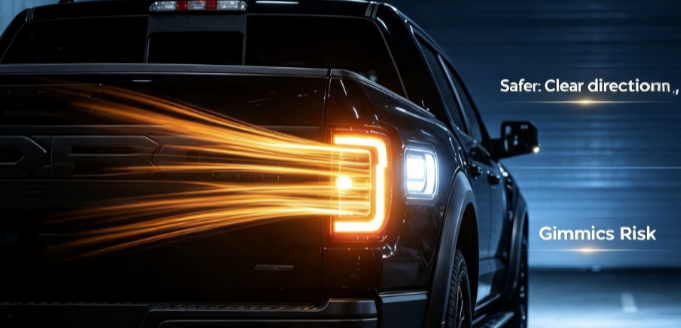
The argument for dynamic turn signals makes intuitive sense. Unlike traditional blinkers that simply flash on and off, sequential turn signals move in the direction of the turn—left-to-left, right-to-right. This motion creates a "chase effect" that naturally draws the human eye. Research on traffic signal visibility suggests that dynamic, moving patterns are more effective at capturing driver attention than static flashes, especially in cluttered visual environments or adverse weather conditions.
For truck lighting and trailer lights, this added visibility isn't trivial. When you're hauling a 53-foot trailer through rain or dusk, every millisecond of reaction time counts. The flowing pattern of LED signals can help following drivers immediately recognize which direction you're heading, reducing the cognitive load of "Is that a brake light or a turn signal?" moments.
There's also the matter of directional clarity. Standard marker lights flash uniformly; dynamic signals literally point where you're going. This can be particularly helpful for reverse lights and turn signals on larger vehicles where spatial orientation matters.
The Style Argument
Let's be honest—part of the appeal is aesthetic. Dynamic turn signals look modern. They signal (pun intended) that a vehicle is well-maintained and equipped with contemporary technology. For fleet operators and owner-operators alike, upgraded LED signals send a message about professionalism and attention to detail.
But here's where it gets interesting: style and safety aren't mutually exclusive. A driver who takes pride in their vehicle's appearance typically maintains it better. Better-maintained brake lights, marker lights, and signal lights make for safer roads. The visual upgrade encourages upkeep.
What Actually Matters in a Turn Signal
Whether you choose dynamic or traditional patterns, certain fundamentals determine real-world performance:
Brightness and Visibility
A turn signal needs to be seen in direct sunlight, heavy rain, and at highway speeds. High-quality LED signals with proper lens design outperform dim or yellowed incandescent bulbs every time.
Durability
Truck lighting takes a beating. Vibration from rough roads, temperature swings from desert highways to mountain passes, and constant exposure to the elements—these factors separate professional-grade trailer lights from consumer toys.
Electromagnetic Compatibility
In a world of CB radios, GPS units, and onboard diagnostics, your signal lights shouldn't interfere with other systems. EMC Class 4 certification matters more than most people realize.
Certification
E-Mark, CE, RoHS compliance—these aren't just bureaucratic stamps. They indicate a product has been tested to actual standards, not just factory claims.
The Smart Middle Ground
Here's an uncomfortable truth: dynamic turn signals can be safer, but only if they're built to perform in real-world conditions. A cheap sequential light that fails after three months of winter driving is worse than a reliable traditional blinker.
This is where manufacturing quality becomes critical. IATF 16949 certification—the automotive quality management standard—ensures that every batch of signal lights meets consistent specifications. It's the difference between "looks good on the shelf" and "works reliably at -45°C when you're hauling freight across Siberia."
What We Do Differently
At Foke LED, we don't chase trends—we build lighting that works. Our dynamic turn signals are engineered for the long haul:
Temperature resilience: Operational from -45°C to +80°C. Because trucks don't stop for weather.
Vibration resistance: High-density aluminum construction that handles rough terrain without failure.
IP67 waterproofing: Submersion-rated seals that keep moisture out of your trailer lights and marker lights.
EMC Class 4: Full electromagnetic compatibility so your LED signals won't interfere with critical electronics.
Complete certification: E-Mark, CE, RoHS—documentation you can actually use for regulatory compliance.
We manufacture everything in-house at our IATF 16949-certified facility. No outsourcing, no mystery suppliers. With over 500 proprietary designs developed by our own R&D team, we understand truck lighting because we design it from the ground up.
One thing we don't do? Smart features. No Bluetooth, no apps, no over-the-air updates. Just robust, well-engineered lighting that does its job without complexity. Because when you're on mile 400 of a night haul, the last thing you need is a software glitch in your brake lights.
The Verdict
Dynamic turn signals occupy an interesting space: they're genuinely more eye-catching than traditional flashers, which can translate to safety benefits. But the effect is only as good as the hardware behind it. A premium sequential signal from a certified manufacturer will outperform a basic flasher; a cheap knockoff won't last long enough to matter.
For fleet managers and truck owners, the question isn't "dynamic or static?"—it's "will this work when I need it?" That's a question of engineering, not animation style.
If you're upgrading your truck lighting, trailer lights, or marker lights, start with build quality. The style will follow.
Explore our full range at www.foke-led.com
Key Differences Between LED Work Lights and LED Agriculture Lights
The Art of Atmosphere: LED Interior Lighting for Yachts
Related Article